
The Real Cost Of A Bad Hire
What does a bad hire really cost? It’s an interesting thought experiment. For example: a finance manager joins your business on a £55,000 salary, and leaves after five months. By that point, you've paid the recruitment fee, their salary, employer National Insurance, pension contributions, the cost of their laptop and setup, and the hours three separate people spent interviewing them. On top of that, two of the reports they were responsible for needed to be redone because their handover was rushed. What did that actually cost you? For almost every business, the honest answer is more than they think.
Bad hires happen, but most organisations sit down and calculate the actual cost of making one. If they do, they’re normally surprised by how big that number is.
This piece breaks it down properly: direct costs, and indirect costs that often get overlooked. It also looks at what industry data says about how often it happens in the first place.
What Exactly Is a Bad Hire?
Most businesses would define a bad hire as someone who turns out to be the wrong fit for the role, the team, or the business, regardless of how strong they looked on paper or how well they performed in an interview. That mismatch might be a skills gap, or a clash in working style. It could be a misalignment in values that only becomes obvious once someone is embedded in the day-to-day. It rarely happens because a candidate has been dishonest; more commonly, it occurs due to a recruitment process that doesn’t test for the right things.
Why Getting A Hire Right First Time Matters
The Chartered Institute of Personnel and Development regularly surveys UK employers on their recruitment costs and outcomes. Its data consistently puts the cost of a failed hire, which they define as someone who leaves or is let go within the first year, at a minimum of £8,000 to £12,000 for junior roles, rising sharply with seniority.
The Recruitment and Employment Confederation pitches this figure much higher, suggesting a poor hire at manager level costs UK businesses an average of £132,000 once you factor in productivity loss, management time, and the impact a bad hire can have on team performance are properly accounted for.
These figures vary wildly depending on source, but even at the lower end, it’s still a lot of money. In most organisations, the cost of a bad hire is also usually invisible, because nobody sits down and works it out.
Where the Cost Actually Comes From
The direct costs
Start with what's easiest to count. Let’s consider the example from above – a Finance Manager at £55k.
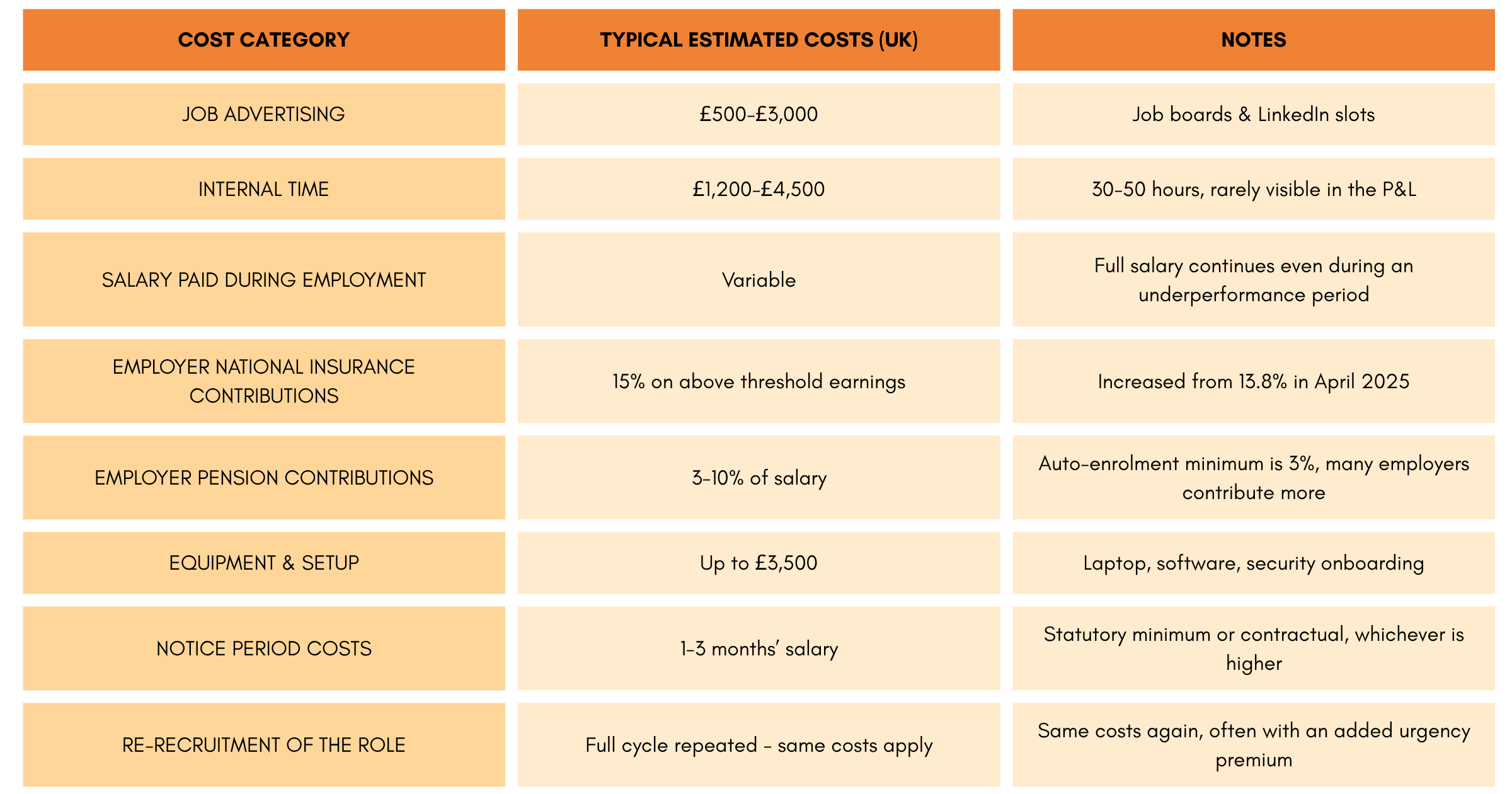
For a £55,000 role, the direct costs alone, before you count one single hour of lost productivity, can be over £30,000 for a hire who leaves within six months. Add in the re-recruitment cycle, and £50,000 in hard costs is a realistic total.
The indirect costs nobody logs
Lost time filling the role
Roles are typically open for four to eight weeks while they’re advertised, and interviews are carried out. Then you wait for your new hire’s notice period to run out. Data from LinkedIn (https://business.linkedin.com/hire/resources/talent-acquisition/reducing-time-to-hire) puts average UK time-to-fill for professional roles at 43 days, and that's from a standing start with a clear brief, not a rushed re-hire after an unexpected departure.
The productivity drag while they're in post
Bad hires don’t usually just sit at their desk doing nothing. More often, they’re people who do things slowly, or consistently make the same mistakes. They create more work for everyone around them. Underperforming employees are consistently found to operate at a lower level of productivity of a solid hire in the same role, as well as dragging those around them down too. So, hypothetically, on a role that generates or supports £300,000 of annual value, six months at 40% output means roughly £90,000 has quietly gone missing.
Management time
Dealing with a poor performer costs far more management time than most people budget for. Check-ins, performance plans, conversations with HR, documentation, escalations. Managers typically spend 17% of their time in a month managing an underperformer (https://press.roberthalf.com/2012-11-08-Survey-Managers-Spend-Nearly-One-Day-a-Week-Managing-Poor-Performers), which at a senior manager's loaded cost works out to £1,200-£3,600 a month, for as long as the situation runs.
Team morale and retention risk
This one’s hard to put a number on it, but we shouldn’t ignore it. Strong performers notice when someone isn't pulling their weight and it’s not being managed – it signals that standards may have slipped, and in the worst cases, it can drive your other employees to look elsewhere. Losing a strong performer out of frustration can end up costing more than the bad hire did.
Client and stakeholder impact
In client-facing roles, a bad hire is often felt by clients before it's fully visible internally. They miss deadlines and they don’t communicate properly. By the time this shows up in a formal appraisal or probation meeting, typically 3-6 months in, that stakeholder relationship might already be damaged. You can’t really put a figure on this, but depending on the work your bad hire does, it can run into the thousands.
The opportunity cost
There's a third issue beyond direct and indirect costs: the things that didn’t happen because you hired the wrong person. A finance manager who was meant to overhaul monthly reporting didn't. An HR lead who was meant to fix a broken onboarding process didn't. The role existed because the business needed something done, and that need went unmet for the time your bad hire was in post, plus the time it takes to re-hire for it. This is often the biggest impact of all, especially for senior roles, but it’s also hard to quantify. Many “bad hire” calculations leave it out and wind up understating the real figure.
Why Bad Hires Actually Happen
It's easy to assume a bad hire comes down to a dishonest candidate or an unlucky personality clash. It’s not always the full story.
- A rushed process: You’ve got an urgent vacancy so the timelines get shortened. The brief gets written in a hurry because the hiring manager is busy doing their day job, and the bar drops because the business “needs someone now”. This is the single biggest driver of bad hires.
- Poor interview design: Unstructured interviews built around a general chat and a gut feeling have consistently poor predictive value for job performance. Structured interviews, that are repeatable and scored against a clear rubric, perform far better. But still, most businesses don’t use them consistently.
- Leaning too heavily on the CV: A strong CV shows someone can present their experience well. It doesn't tell you whether they’ll be a good fit in your business, work well with your team, or gel with your management style.
- An unclear role: Sometimes the hire isn't the problem, the role is. If nobody is defining what success should look like 90 days in, even the strongest candidates can be set up to fail.
CIPD's Resourcing and Talent Planning Survey found that 41% of UK employers had made a hiring decision in the previous 12 months that they later regretted. The most common cause given wasn't candidates being dishonest. It was hiring under pressure instead of taking your time and waiting for the right person.
How to Reduce the Risk
1. Write a proper brief before the role goes live
Define what good looks like at 90 days. Get the hiring manager to define the three most critical skills for the role, and get them to outline the wider context of the hire. A precise brief produces a better shortlist every time.
2. Use a structured interview process
Ask the same questions in each interview and score them the same way, for every candidate. It may feel rigid, but it lets you compare with less bias.
3. Slow down when it feels chaotic
This can be the hardest to follow, but it’s the most important advice, in our opinion. If your brief has changed multiple times, there are 9 people on your shortlist, or someone is suggesting lowering expectations or upping the salary, it’s time to pause. A three-week delay to get the right person is cheaper than six months with the wrong one.
4. Bring in a specialist recruiter
A recruiter working across both clients and candidates day to day is better placed to catch a mismatch early, because they go through the hiring process more often than you do. They go through screening conversations and interview-type questions with candidates every day, and can spot red flags more readily than many hiring managers can. They can also open up access to strong candidates who aren't actively job hunting. A recruitment fee pays for itself in the long run.
FAQs
What is the average cost of a bad hire in the UK?
CIPD data suggests £8,000 to £12,000 as a minimum for junior roles. REC research puts the cost of a poor management-level hire at roughly £132,000 once productivity and team impact are included. It can vary, but it’s usually thousands of pounds that many businesses don’t account for.
How common are bad hires?
CIPD's 2024 survey found that 41% of UK employers had made at least one hiring decision in the past 12 months that they later regretted. Industry estimates more broadly suggest somewhere between 10% and 25% of hires don't work out in their first year, depending on sector and seniority.
Can a bad hire situation be turned around?
Sometimes, particularly if the issue is a skills or expectations gap rather than a behavioural or cultural mismatch. Clear feedback, a defined improvement plan, and an honest conversation early on give the best chance of success. Where the root cause is behavioural, it's far less likely to resolve with time alone.
Key Takeaways
- The true cost of a bad hire is bigger than most businesses assume, and most of it never makes it into a spreadsheet.
- Direct costs (fees, salary, NI, pension, equipment) for a mid-level hire who leaves within six months can reach £50,000 before productivity loss is even counted
- Indirect costs, lost time filling the role, reduced productivity in post, management time, and morale, often outweigh the direct costs
- REC research puts the average cost of a poor management-level hire at around £132,000 once these factors are included
- CIPD data shows 41% of UK employers made a hiring decision in the past year they later regretted, most commonly caused by hiring under time pressure
- A clear brief, structured interviews, proper reference checks, and the discipline to slow down when it's tempting to rush are the most effective ways to reduce the risk
How Sewell Wallis Can Help
The cost of getting a hire wrong is one of the strongest arguments for getting the process right the first time. If you're recruiting for a finance or HR role and want a specialist eye on the brief, the interview process, or your onboarding, get in touch with the Sewell Wallis team.
About The Author
Kayley Haythornthwaite is the Joint Managing Director of Sewell Wallis, with over 15 years of experience recruiting specifically for the finance market across South and West Yorkshire. She oversees the senior finance and executive search teams, leveraging an unrivalled network to place leadership talent in industry, practice, and not-for-profit sectors. Her deep regional knowledge allows her to provide strategic counsel on salary benchmarking and talent acquisition trends.
