Save Time: Use A Recruiter
Hiring for your finance team is a great positive, but it can also be a big drain on your budget and time. We see this most often in SMEs – small teams can become quickly overwhelmed when they try to grow.
If you are managing the process yourself without internal recruitment support, the hidden time cost can be more than you think.
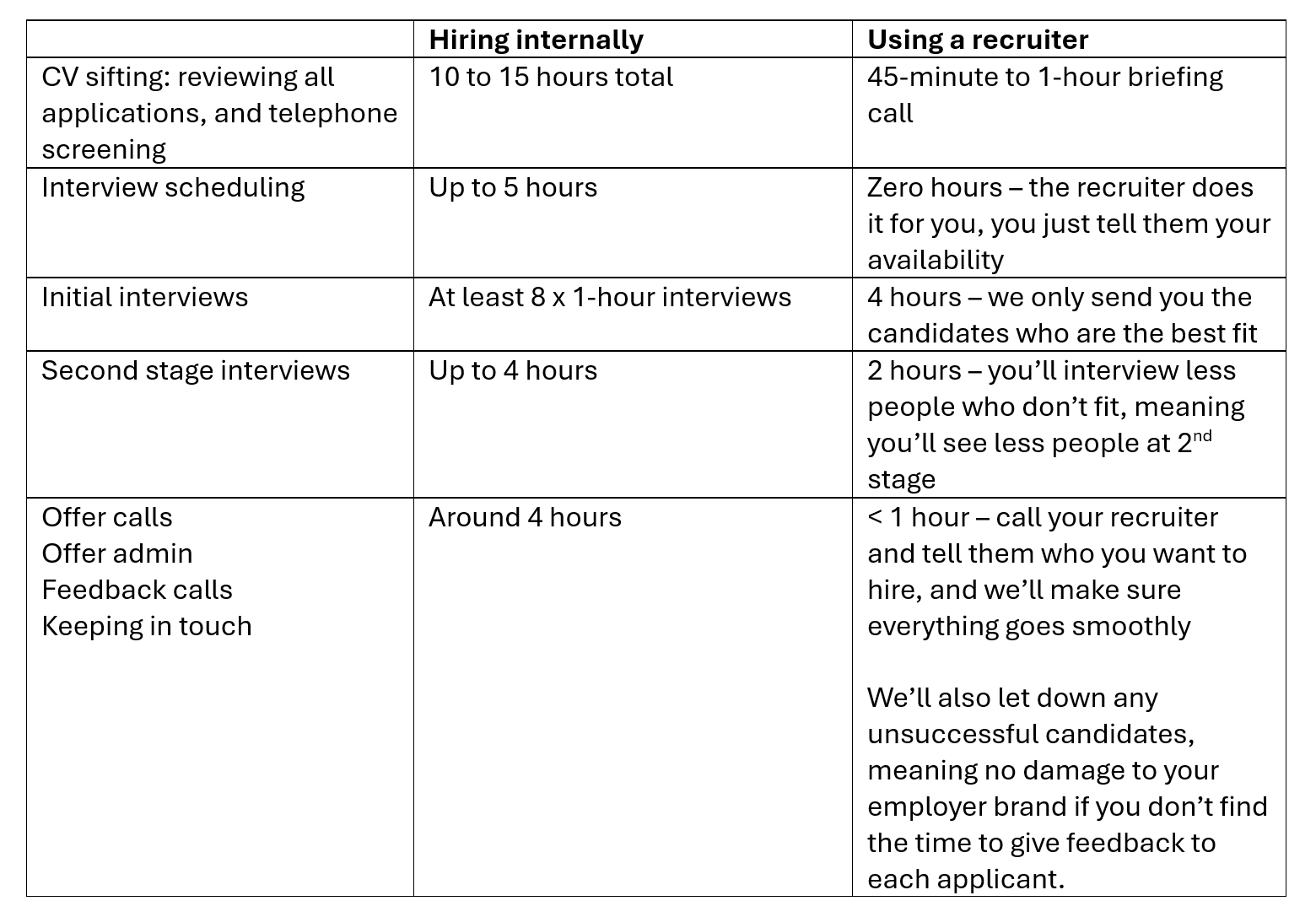
On average, hiring a finance role internally can cost you around 27 hours of your time - time you’re not spending running your business.
The short answer: how long does it take to hire a finance role?
For SMEs and smaller businesses hiring without specialist support, the process can take several weeks and 25 to 30 hours of internal time – sometimes even more.
Working with a specialist recruiter like Sewell Wallis can reduce that significantly; on average, our shortlists are typically delivered in around 3 days from brief.
Where does the time actually go?
Most hiring managers underestimate how much time gets pulled into recruitment.
Let’s compare hiring internally vs using a recruiter – it really highlights where you’ll save time. These are approximations, but they’re based on our experience recruiting into Yorkshire businesses for over two decades.
Why does this hit SMEs harder?
In larger businesses, hiring is typically shared – they have internal HR functions and sometimes their own internal talent teams.
But in SMEs, it usually sits with finance leaders, business owners and heads of department, who all have their own schedules and full workloads to manage.
Every hour spent on hiring is an hour taken away from:
Financial and business planning Commercial decision making Team management and leadership
There is also the added risk of:
Poor candidate experience damaging your reputation Losing strong candidates due to slow processes Making a rushed or wrong hire under pressure
What does a bad hire actually cost?
The financial impact of a bad hire is often underestimated.
Industry estimates suggest the cost can range from 30% to 150% of the employee’s salary, depending on seniority.
So, let’s look at an example. For a £50,000 finance role, that could mean up between £15,000 to £75,000 in real cost. This is made up of lost productivity, time spent rehiring, and onboarding and training costs – time spent is money spent, after all. It can also impact team morale and cause costly commercial mistakes. For smaller businesses, that level of loss hits a lot harder.
How a recruiter saves time, cost, and risk
Working with a specialist finance recruiter isn’t just about filling the open role; it’s about removing inefficiencies and time sinks from the process.
Here’s where the difference is:
1. Immediate access to the right candidates
The best candidates aren’t applying to job ads. If you advertise the role yourself, you’re only accessing people who are actively looking for a job – about a quarter of the people a recruiter could access for you.
Working with a recruiter link Sewell Wallis gives you access to an established passive network built over two decades in the Yorkshire market. You get a direct line into talent you wouldn’t find on your own; so many of the people moving jobs aren’t ‘actively looking’ when they’re you’re advertising, but if a consultant approaches them directly, there’s more of a chance they’ll engage.
2. Faster shortlists
If you try to do it alongside your day job, you can spend weeks filtering applications. With a recruiter, you save all of that time – Sewell Wallis will have a shortlist with you in 3 days on average.
This part of the process is where a large portion of your 27 hours disappears.
3. Reduced risk of a bad hire
A structured, consultative process with an experienced recruiter means you make fewer rushed decisions and you have a partner who you can rely on to help you make the right choice. With a 93% retention rate after 12 months, our focus at Sewell Wallis is on long-term fit, not quick wins.
4. Less admin, fewer headaches
Interview coordination, candidate management, offer handling, candidate questions – it’s all taken off your plate, meaning you get to focus on decision making, not process management.
Common mistakes SMEs make when hiring finance staff
If you are hiring internally, these are the patterns we see most often:
- Over-reliance on job boards
- Underestimating market salary expectations
- Moving too slowly and losing candidates because of this
- Rushing decisions at the final stage
If any of those sound familiar, our guide breaks it down further.
Planning a senior hire? Read this first
For more senior roles, the stakes are even higher.
Our guide covers what to expect when hiring finance leaders.
Salary expectations in the current market
If you are unsure what you need to offer to attract the right talent, our latest salary survey will give you a clear benchmark: Click here for your free copy.
Final thoughts
For SMEs, every hire matters. Spending any unnecessary time on a process that could be handled for you isn’t just inefficient, it’s expensive. The real question you should be asking yourself isn’t whether you can manage your hiring process yourself – it’s whether you should.
Planning a finance hire in Yorkshire?
Take a look at how we support businesses like yours here.
Or, if you want a quick, practical view of your role, timelines, and candidate availability, contact us today and we’ll map out the process for you.
We’ll help you get it right the first time, without losing weeks of your time in the process.